| ..: MAIN MENU :.. |
| Register |
| Login |
| Reviewer |
| Focus and Scope |
| Editorial Team |
| Indexing |
| Contact |
| ..: SUBMISSION :.. |
| Author Guidelines |
| Submit Paper |
| Open Access Policy |
| Author Fees |
| ..: PUBLICATION :.. |
| Peer Review Process |
| Publication Ethics |
| Copyright Notices |
| Archiving Policy |
| Crossmark Policy |
| AI Tools Policy |
| Plagiarism |
| ..: ARTICLE TEMPLATE:.. |
|
|
|
|
| ..: INFORMATION :.. |
| Readers |
| Authors |
| Librarians |
| ..: TOOLS :.. |
 |
 |
 |
 |
| ..: STATISTIC VIEWS :.. |
|
|
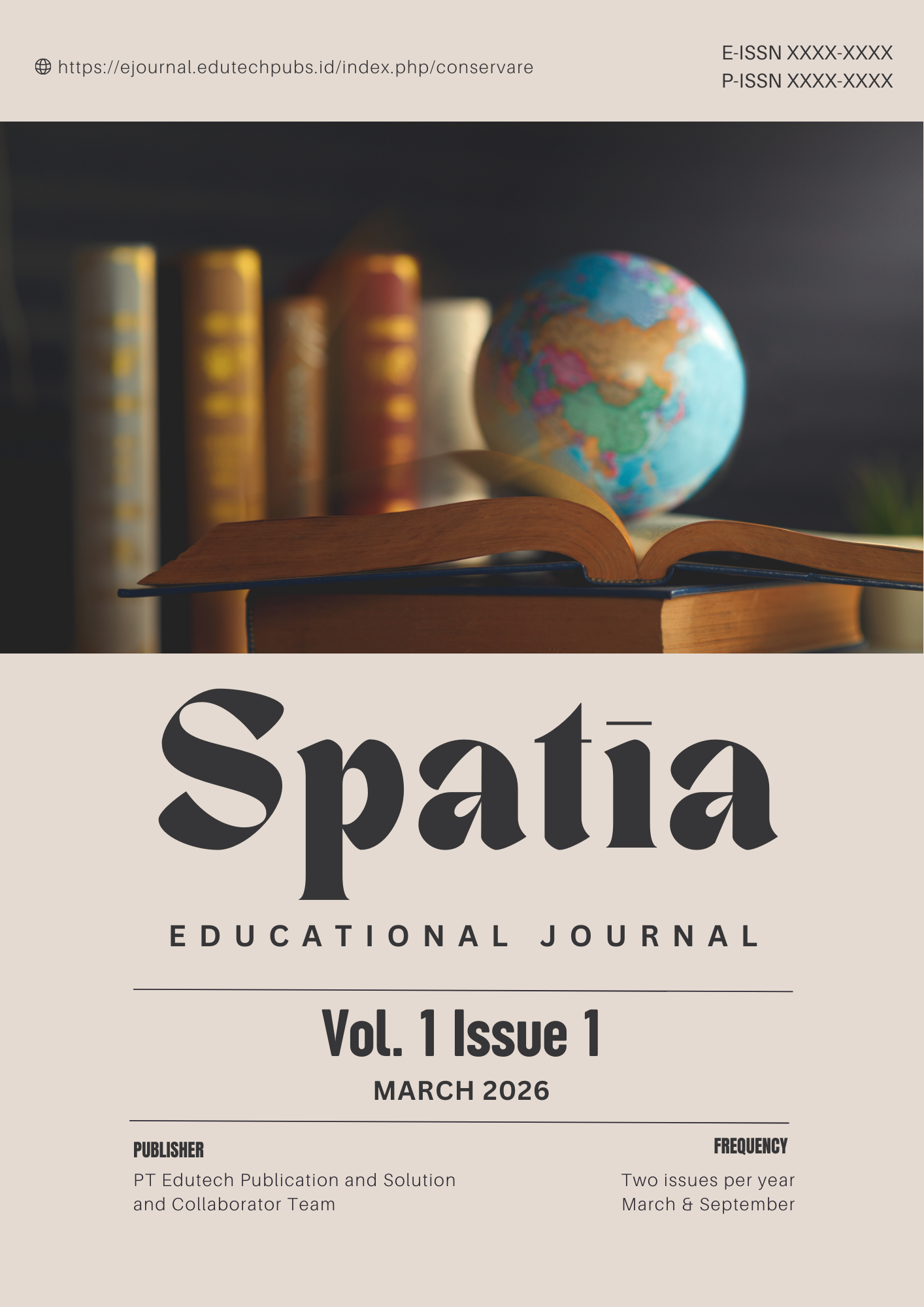
About the Journal
SPATIA: Educational Journal (e-ISSN: 3163-7442, since July 24th, 2026) is a scholarly publication dedicated to the advancement of theoretical and empirical research in the field of education through spatial, contextual, and interdisciplinary perspectives. The journal publishes original research articles, literature reviews, and conceptual papers addressing instructional strategies, curriculum development, educational evaluation, learning technologies, and teacher professional development. SPATIA places particular emphasis on the integration of spatial approaches, environmental perspectives, and local wisdom within educational practices, including geography education, social studies education, and place-based learning. It also encourages studies on the application of digital technologies, geographic information systems in education, and innovative 21st-century learning models that respond to social and global transformations. Upholding rigorous academic standards and a peer-review process, SPATIA: Educational Journal aims to serve as a credible and impactful platform for scholars, researchers, educators, and policymakers to disseminate knowledge, foster academic dialogue, and contribute to sustainable educational development at national and international levels.
Current Issue
Vol. 1 No. 2 (2026)
Published:
2026-10-14